Sea urchins see with their whole body

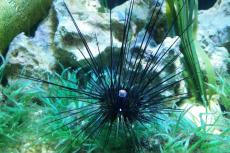
Study reveals that spiny invertebrates utilize their feet as retinas. From the ends of their "feet" to the tips of their spines, sea urchins may utilize their bodies as one big eye.

According to a study that appeared in the Journal Proceedings of the National Academy of Sciences, new research has indicated that sea urchins may use the entire surfaces of their bodies—from the ends of their "feet" to the tips of their spines—as huge eyes. Scientists have long known that marine invertebrates react to light without any obvious eye-like structures, raising the question of how the animals see.
Previous genetic analysis of the California purple sea urchin revealed the animals possess a large number of genes linked with the development of the retina—the light-sensitive tissue lining the inner eyeball in people and other vertebrates.
Eyes scattered across their body
In conjunction with other research, it is now theorized that sea urchin vision may rely on light-receptor cells randomly scattered across their skin, which collectively function like retinas. Scientists had suspected the animals' spines simulate the light-blocking pigmented cells found in most animals' eyes. As light-receptor cells in the retina soak up light from every direction, pigmented cells work to block light from the back and the sides so animals can "see" what's in front of them.
It has now been discovered that two distinct groups of bristly, light-receptor cells are concentrated at the bases and tips of the purple sea urchin's 1,400-plus tube feet. Situated on the undersides of sea urchin bodies, the long, suction-tipped tubes help the organisms move.
Sea urchins use their tube feet as retinas and the rest of their bodies to shield against the extra incoming light
Researcher Maria Ina Arnone
Feet as retinas
Sea urchins use their tube feet as retinas and the rest of their bodies to shield against the extra incoming light, said researcher Maria Ina Arnone, a developmental biologist at Anton Dohrn Zoological Station in Naples, Italy. Previous studies discovered the number and placement of spines could affect the sharpness of its vision and this new find "might well be part of the picture," Arnone added.
- Log in to post comments