You wonder, sometimes, how things link up. For example, how is a scuba diving suit connected to the likes of household names such as Dr Who, Casino Royale, Trainspotting, Star Wars Episode I: The Phantom Menace, Basic Instinct II, Atonement and the latest Ridley Scott/Russell Crowe epic, Robin Hood?
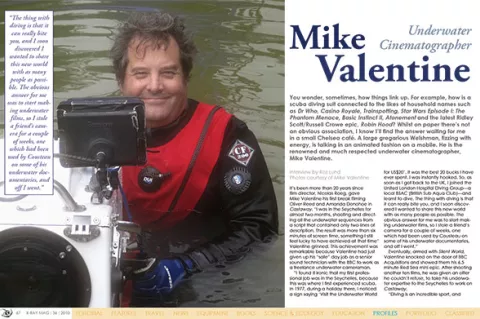
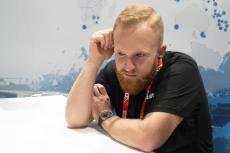
Whilst on paper there’s not an obvious association, I know I’ll find the answer waiting for me in a small Chelsea café. A large gregarious Welshman, fizzing with energy, is talking in an animated fashion on a mobile. He is the renowned and much respected underwater cinematographer, Mike Valentine.
Contributed by
It’s been more than 20 years since film director, Nicolas Roeg, gave Mike Valentine his first break filming Oliver Reed and Amanda Donohoe in Castaway. “I was in the Seychelles for almost two months, shooting and directing all the underwater sequences from a script that contained only two lines of description. The result was more than six minutes of screen time, something I still feel lucky to have achieved at that time” Valentine grinned. This achievement was remarkable because Valentine had just given up his “safe” day job as a senior sound technician with the BBC to work as a freelance underwater cameraman.
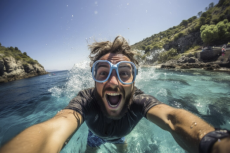
“I found it ironic that my first professional job was in the Seychelles, because this was where I first experienced scuba. In 1977, during a holiday there, I noticed a sign saying ‘Visit the Underwater World for US$20’. It was the best 20 bucks I have ever spent. I was instantly hooked. So, as soon as I got back to the UK, I joined the United London Hospital Diving Group—a local BSAC (British Sub Aqua Club)—and learnt to dive. The thing with diving is that it can really bite you, and I soon discovered I wanted to share this new world with as many people as possible. The obvious answer for me was to start making underwater films, so I stole a friend’s camera for a couple of weeks, one which had been used by Cousteau on some of his underwater documentaries, and off I went.”
Eventually, armed with Silent World, Valentine knocked on the door of BBC Acquisitions and showed them his 6.5 minute Red Sea mini epic. After shooting another ten films, he was given an offer he couldn’t refuse, to take his underwater expertise to the Seychelles to work on Castaway.
“Diving is an incredible sport, and something that I dearly love. When it comes to work, the diving I do is completely different. I’ve often noticed that recreational divers think that they can get into the film or television industry because they dive. It’s not quite that simple.
“Diving is just the means of getting to work. I dive whilst other people catch a train. It’s what you do when you get to work that counts. In this day and age, it’s never been easier for someone to pick up a video camera and shoot underwater and call themselves a director of photography or a camera operator.” said Valentine. (A director of photography, or cinematographer, is the chief of the camera and lighting crews on a film, and therefore responsible for achieving the artistic and technical decisions related to the image).
What matters
“At the end of the day, whilst you can use technology to help achieve an improbable shot, the one thing you can’t buy, skip or fast forward, is experience. This is such an important thing, and good production teams know and appreciate that in the long run—having experienced personnel will save them money. It’s not uncommon for me to have a meeting with the producer during pre-production and for them to remark that, “We’ve storyboarded the sequence, but we don’t know how to shoot it, and we don’t think it will work.
“Therefore, experience is an invaluable tool in my job. I not only have to work out how we will physically achieve the image desired, I have other major considerations, too, such as ensuring we stay within budget and timescales, logistics, and most importantly, actor and crew safety. After working on over 80 features, I can still say that every day we go to work is still fun, because I feel that we are still unlocking the door of the underwater world and sharing its beauty with as many people as possible,” said Valentine.
“We”
“I say ‘we’ and I do mean, We. I could not achieve what I do on my own. I am part of a very strong team, and it’s the only way we could do what we do successfully. You’ve watched us work, Roz, and observed that not all of our team scuba dives. Instead ....
(...)