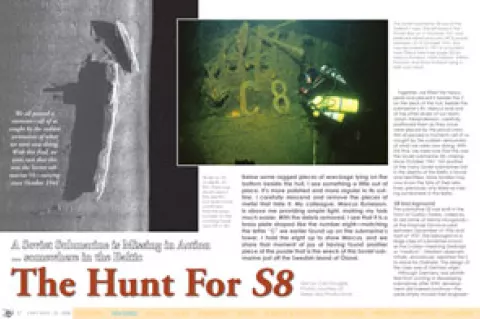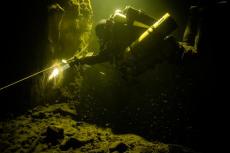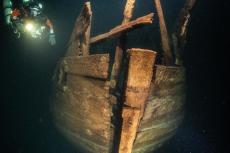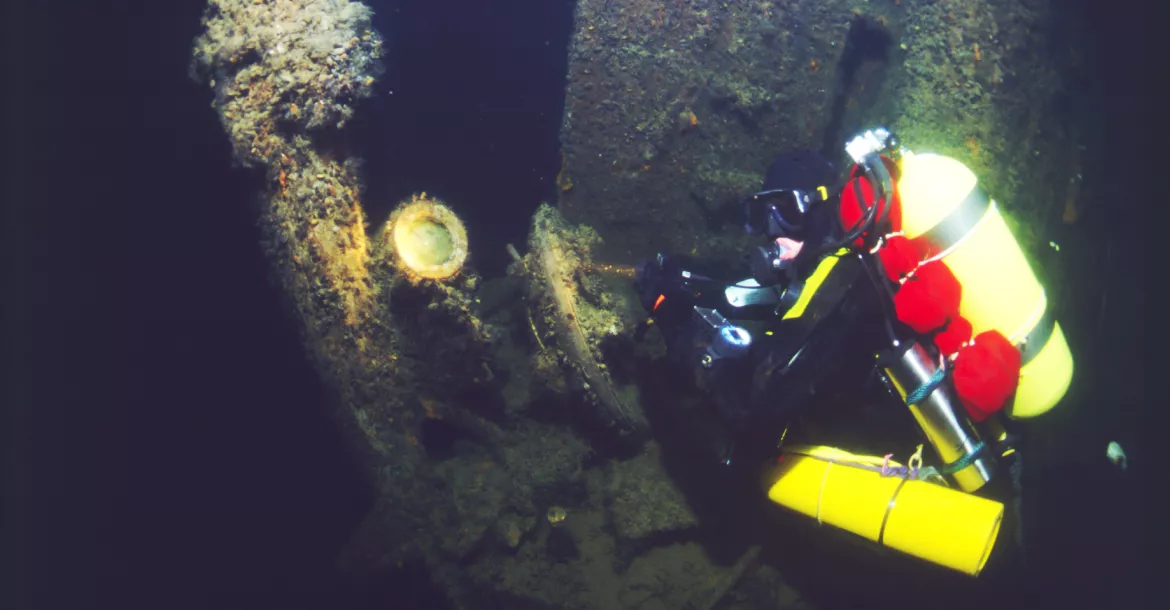
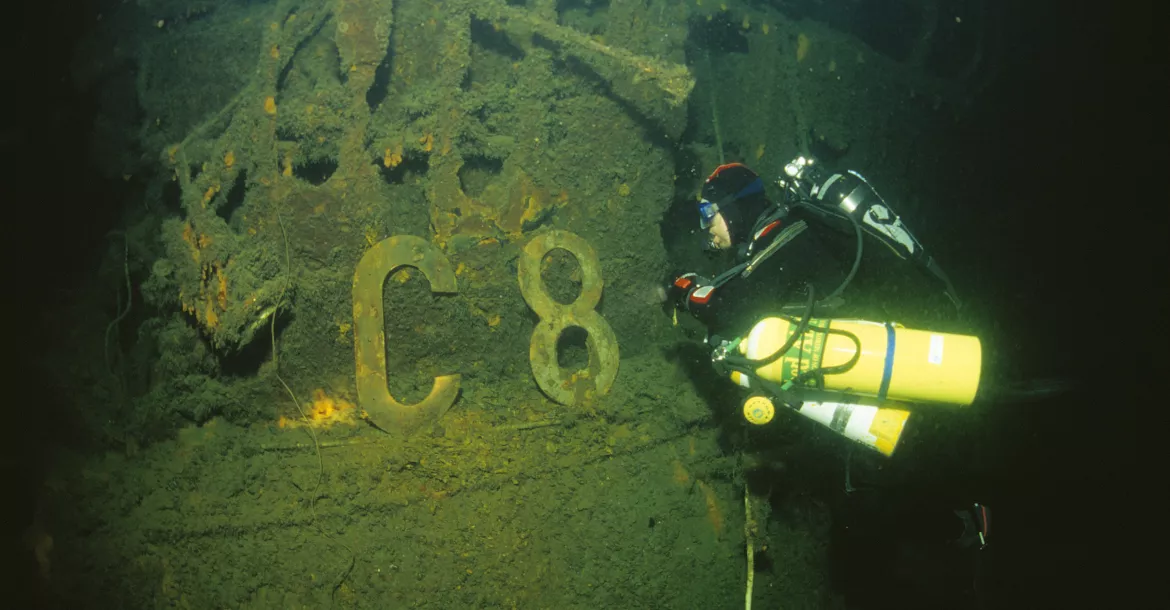
Below some ragged pieces of wreckage lying on the bottom beside the hull, I see something a little out of place. It’s more polished and more regular in its outline. I carefully descend and remove the pieces of metal that hide it. My colleague, Marcus Runesson, is above me providing ample light, making my task much easier. With the debris removed, I see that it is a brass plate shaped like the number eight—matching the letter “C” we earlier found up on the submarine’s tower.

Contributed by
Together, we lifted the heavy plate and placed it beside the C on the deck of the hull, beside the submarine’s fin. Marcus and one of the other divers of our team, Johan Alexandersson, carefully, positioned them as they once were placed by the proud crew. We all paused a moment—all of us caught by the sudden seriousness of what we were now doing.
With this find, we were sure that this was the Soviet submarine S8—missing since October 1941. Yet another of the many Soviet submarines lost in the depths of the Baltic is found and identified. More families may now know the fate of their relatives, previously only listed as missing somewhere in the Baltic.
S8 background
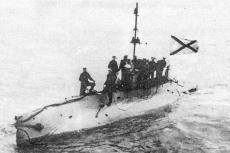
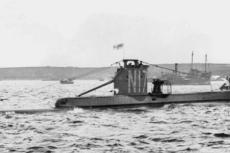
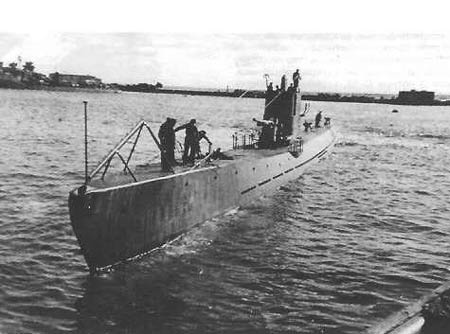
The submarine S8 was built in the town of Gorkiy—today, called by its old name of Nishniy-Novgorod—at the Krasnoje Sormovo-yard between December of 1936 and April of 1937. She belonged to a large class of submarines known as the S-class—meaning Srednaja or “medium”. (Western observers initially, erroneously, reported the S to stand for Stalinets). The design of the class was of German origin.
Although Germany was prohibited from owning or developing submarines after WWI, development did indeed continue—the yards simply moved their engineering departments to Holland. Several countries, in addition to the Soviet Union, purchased designs from the joint firm, among them Sweden, Finland, Spain and Holland. The German engineers further refined the design, eventually resulting in the long-distance Type IX class for the German Navy.
The S8 was commissioned into the Soviet Navy’s Baltic Fleet on June 30, 1940. The first year was spent working up the crew and preparing for the war that loomed.
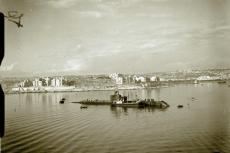
When Nazi-Germany attacked on June 22, 1941, the S8 was based at the large submarine base at Ust-Dvinsk—today’s Daugavgriva—just north of Riga, Latvia. Along with seven other submarines, she belonged to the 1st Division of the 1st Brigade of the Baltic Fleet. Shortly after the outbreak of war, the S8 was sent to sea along with those submarines that were serviceable.
As the Nazis advanced, the Soviet submarines were forced back, first to Tallinn in Estonia and finally to the bases around Leningrad—today’s St. Petersburg— at the end of August. It was not until early October 1941 that the S8 could be dispatched for a full combat patrol, together with three other boats of the smaller SHCH-class.
The force was tasked with interdicting the shipping carrying iron-ore from neutral Sweden to Nazi-Germany in the area between Norrköping and the island of Öland. Just one of the four boats survived its mission and returned to its base.
On October 11, 1941, Captain Ilia Braun of the S8 radioed what was to be his final report. He stated that he had reached a position just north of the Estonian island of Dagö in the Bay of Finland. After the S8 became overdue from her patrol, it was assumed that she had been lost just after her last report, either from one of the thousands of mines Finland and Germany had sowed in the Gulf of Finland, or possibly sunk by another submarine (as had her sister ship the S7 was later to be sunk by the Finnish submarine, Vesihiisi). Her crew joined the many millions of Soviet soldiers reported missing in action during WWII.
The discovery
In June, our group from Kalmar’s Scubasport dive store left port to make side scan images of two previously located wrecks—the Nicomedia (one of four ships sunk by the Royal Navy submarine E19 on October 11, 1915 and the Emmy Haase.
Along for the ride was also Sture Hultqvist with his homemade “lucky” side scan sonar.
This equipment had previously located both the so-called “champagne wreck”, Jönköping, where some 1,600 bottles of 1906 Heidsieck champagne were salvaged, and the Soviet submarine S7.
After completing the imagery and diving the Emmy Haase, the vessel headed south toward the other wrecks. The sea was very rough, and only Marcus and the young son of the skipper were not seasick.
Marcus consulted his charts and asked that a small detour be made, so that he could check a position, which some local fishermen had given one of our project leaders, Mats Karlsson. They had reported retrieving aluminium-parts from their trawls—most likely from the wreck of an aircraft.
Marcus picked up the story: “It was between nine and ten in the evening, and the sun was just setting. Stefan [Fransson], was at the helm, and I manned the side scan sonar.
After just 15 minutes of searching around the position we had been given, there was a very clear wreck on the screen. I screamed out loud and ran down to get the others, lying below and being seasick.”
They were a bit slow to make their way up to the bridge—Mats thought Marcus was joking with them. But after a while, both Mats and another of the group, Sture, made the effort to come up to see what they had found.
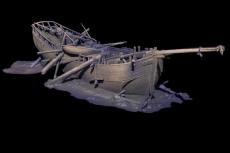
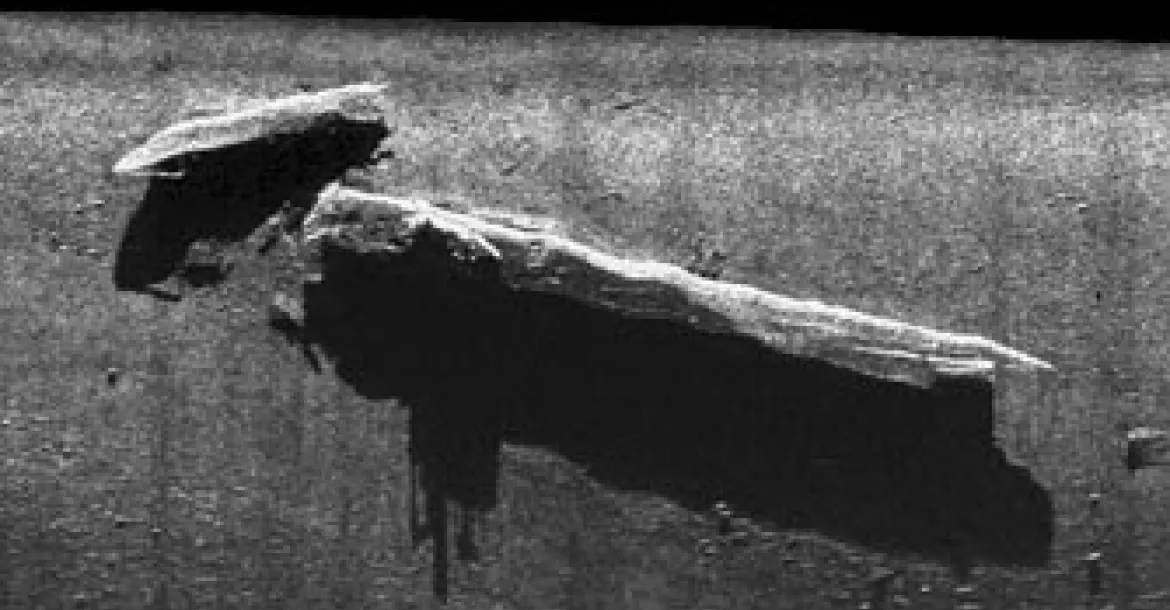
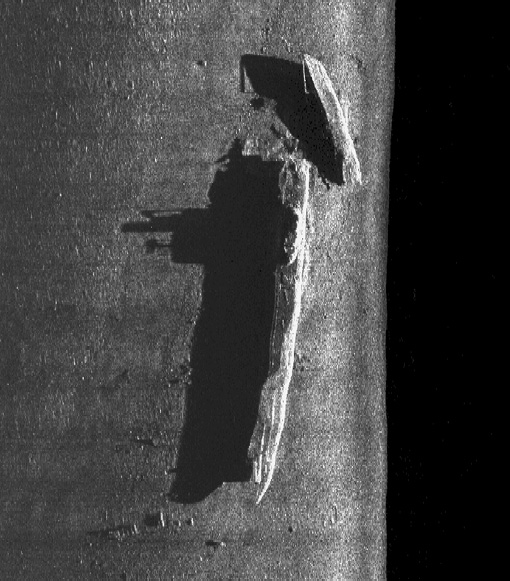
What they saw on the screen was an elongated cigar-shaped object. What could it be? An airplane or some unknown mystery-ship? A torpedo boat or another type of long and narrow vessel? After doing another few turns over the position of the wreck, the group decided to head south to the wreck of the Nicomedia to get the side scan images they needed, and then return to dive the mystery-wreck in the morning.
The first dive
At six in the morning, Mats was still too seasick to dive, so Marcus and another diver in our group, Stefan Fransson, made the first dive on the new wreck. All they had was air, so the plan was to just make a very brief dive to try to ascertain what was down there.
It was at a depth of 45m where Marcus first saw an outline of a hull on the bottom.
Lit up by his torch light, he saw an anchor, some sort of hand rail and a half moon-shaped porthole without glass. Although affected by nitrogen-narcosis, Marcus and Stefan spent another ten minutes on what they agreed was the bow of some sort of ship before ascending.
On the surface, the rest of the gang waited anxiously. Sture was using Photoshop to make the side scan images more clear. When the divers reached the boat, Mats called out the question on everyone’s mind, “Was it an airplane?” and Stefan answered with irony, “Do airplanes have anchors?” After listening to the divers’ report and analysing Sture’s images, the group arrived at the startling conclusion that they had probably found a submarine.
Back in Kalmar, they contacted the maritime historian, Björn Åkerlund, who started searching for clues in the available literature. Nowhere was there any indication of a submarine sunk in the area where the wreck was found. As the research continued, they focused more and more on submarines lost during the First World War. The main reason behind this was that due to the improvements in communications during the interwar years, more is known about where submarines were lost during the Second World War. In the earlier war, the very primitive radios available meant that very little could be known about how and where many submarines were lost.
The group arrived at a list of possible submarines that could be the one they had located.
The most likely candidate was the Russian submarine Lvitsa (lioness) lost on or about June 11, 1917, somewhere south of the island of Gotland. Other possible choices were the British Royal Navy submarine E18, the sister boat of Lvitsa called Gepard or possibly some unknown German boat.
Mission: Identify and Document
Immediately after coming ashore after finding the wreck, Marcus called the undersigned and wanted me to come document the wreck and, naturally, try to identify it. The group also informed the media of their find, which led to a lot of speculation as to what it was they had found. On the Russian side, there was great scepticism as to the possibility that it could be the Lvitsa.
Finally, one month after the initial discovery—after a number of aborted attempts on account of weather—we left port on July 29 to try to ascertain which submarine it could be. On the way out, I went over with the group the various details on the hull for which we would be looking in order to try to at least narrow down the number of possibilities.
I went over such things as the shape of the fin, the shape of the conning tower, the placement of the rudders, anchor and hatches, the hull cross section and measurements, the types and placement of any deck-guns, and the number of torpedo tubes. For this dive, we would keep the number of questions pretty basic.
The first of our team in the water would be Johan Alexandersson and Jonas Dahm, with the task of photographing the wreck and any discernible details from my list. The second group would be the video team, consisting of Marcus, Lena Cloffe, Robert Westerberg and myself.
After giving the lead team a half hour of lead time, we jumped in, formed up, and descended into the darkness. Halfway down, we encountered Johan and Jonas, well into their decompression. They appeared content with their dive and signalled us to go on.
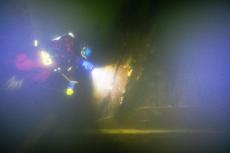
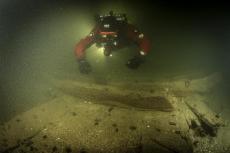
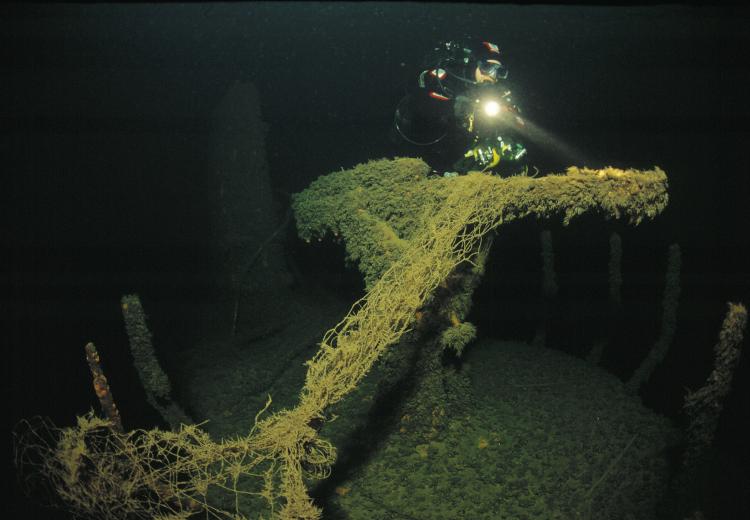
We proceeded down the line. It got darker and darker. Suddenly, I was on the wreck. I landed on the deck just aft of the fin and quickly adjusted the camera and lights. Visibility was very good—between 10 and 15 meters. The hull appeared to be in good shape, very little marine growth was visible on it.
What I saw around me, however, didn’t look right at all. It was much too clean and streamlined in relation to the pictures I’d memorized of the Lvitsa, the E18, the Gepard, and the other possible candidates from WWI.
When I swam over toward the fin, I noted that the shape of the rear part for the fin and the little platform with its anti-aircraft cannon looked vaguely familiar. I took in the aft lantern, the railing around the platform, the shape of the actual gun, and the housing for the periscopes just forward of the gun. I tried to keep some healthy doubt and not fall immediately for the too obvious, easy answer to our questions.
I continued swimming along the deck beside the fin. A little further, I had to acquiesce to my initial gut reaction—this was a sister ship to the S7, the Soviet WWII submarine we had discovered the year before, north of Stockholm. I looked over to my dive buddy
Robert, and we both nodded slightly. He had noticed the same things that I had.
My first thought was that this sub was not supposed to be here. In all my research, I had found no indication that any Soviet submarine had been sunk in this area. It’s naturally an absurd thought—it’s here, after all.
We made our way forward. Marcus and Lena swam ahead, and Robert helped me with lighting. We noticed that the forward section of the fin showed severe damage, and that the main 100mm deck gun was missing from its place in front. The explanation came a few meters later. It was as if a giant wielded an enormous axe cutting the ship in two. The cut was very clean; just a meter aft of the cut, the hull was intact.
I swam on toward Marcus’ light. He had found the bow section lying on its side a few meters away to the right. We moved on and inspected the characteristic net cutter in the bow. I videoed the entire bow with stabilizers, anchor and all the details that I could find, in order to ease final identification.
Going aft again, we looked at the port side of the fin. The weather shield had been completely torn away. We looked straight in on the bridge with a rudder-indicator and opened the hatch. We peeked down and saw all the way down to the main deck inside the sub.
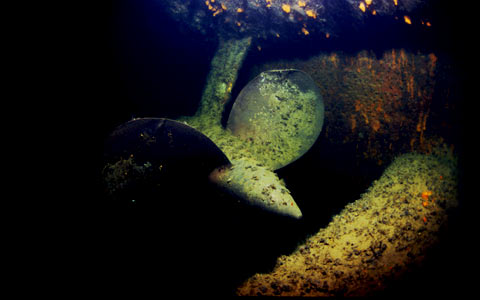
In the stern, we inspected the props and rudders. To my surprise, I discovered a torpedo a quarter of the way out of the port aft torpedo tube. It appeared to be stuck just outside the port of the tube. Suddenly, my lights go out, indicating that it is time to go. After 30 minutes on the wreck, we start the ascent to our first decompression stop.
Immediately after the dive, we gathered to look at the video and to discuss what we had discovered during the dive. Marcus explained that what he had seen on his first dive was actually the net cutter and anchor in the bow, thinking the former was a railing of some sort. Jonas told us about the letter C he had seen on the port side of the fin. None of us saw it, but fortunately my camera did. The letter is very obvious in the video. We take this as confirmation that it is indeed an S-class boat (in Russian the letter C is pronounced as an S).
Following some discussion and checking in some books, we decided that this sub could be any one of several—among them S2, S4, S6, S8 or S10. All of these were lost during the war in such a manner that one cannot be 100 percent sure of the exact location of the sinking. But which one was this sub? How do we figure this out?
Ever since the notorious submarine-intrusions during the 1980s, any news concerning Soviet subs have been front page news in Sweden. Somehow, the media found out that we were out diving the wreck. Immediately upon our return, journalists started hounding Marcus and the others.
It is impossible to imagine what it is like to have information that the media wants. The group from Kalmar got a quick lesson. There was enormous pressure for them to release our findings. After a few days, the news was released, making the covers of several national newspapers and the national TV newscasts on three networks.
Another attempt …
We returned on August 18th to dive the wreck of the sub again. This time, we had enlisted the help of a Russian dive buddy, Max Mikhaylov, to come with us to Öland. Normally, he is an IANTD instructor and, at the time, ran a dive center in the Maldives. But he just happened to be visiting us when we planned to dive the mystery submarine again.
For him, the coming dive would be a deeply personal quest. He served as a diver in the Soviet Red Banner Northern Fleet in the Kola Peninsula and his father was an officer in the Navy. He naturally felt connected to the crew of the sub and was committed to helping us identify her.
The purpose of the following dive was clear to all—to attempt to ascertain which submarine we had found and to gather information as to how she came to rest where she did. We decided to focus our work around the fin and the area around where she was broken in two. We would spend more time studying these areas in detail to try to answer our questions.
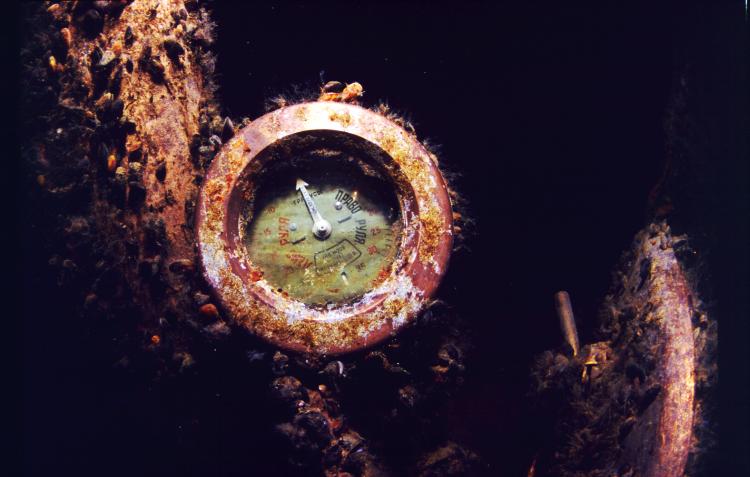
Again, we were lucky, and arrived on the wreck at the fin—this time, just forward of it. We began the dive on the port side of the fin. Max swam around the fin and took in the scene of the wreck. Marcus and Johan inspected the compass hanging down from the wrecked side of the fin. In front of my camera, Johan began to clean and polish the letter C also hanging there. While filming, I look around and discover the brass number 8. After documenting this find, we again move forward and examine both sides of the break in the hull.
Mostly twisted metal, it is difficult to even imagine how it might have looked 50 years ago. After ten minutes, Max signals that his suit is leaking and that he is leaving us. When Johan and I leave the bow area and swim along the starboard side of the hull, we find another set of brass C and 8. After examining the smaller 45mm gun, we again leave the wreck and begin our journey toward the surface.
A very content group returned to shore. After warming up the thoroughly frozen Max, we all shared our observations of the wreck. We had discovered further pieces of the puzzle that this wreck presented. We were all touched by the intense emotions felt by Max after having dived this wreck. The discussions on the way home mostly dwelt on this subject. We all considered what it really meant to dive on wrecks where people had perished.
Back ashore, Max called Alexander Nortchenko of the Russian Navy Submarine Veterans Association in St. Petersburg. He told him about our dive and about the brass figures we had found. Nortchenko was very intrigued by this—he explained that it was a common practice to use brass figures during the 1930’s, but that it was strictly prohibited from about 1940. He had no information of it occurring after this period. However, he did believe that some submarine-captains did use unique marks, such as the ones we had found on the S8, in order to raise the morale of the crews.
Max and Nortchenko agreed that the sub we had found was the S8, despite that it was found in an area other than where it had been reported sunk in 1941. It couldn’t really be any other ship. Nortchenko did not believe any other submarine of the S-class had any reason to be in the area.
The S8 today
Today, the wreck of the S8 is a protected site. No diving, fishing, anchoring or any activity that might disturb this war grave is permitted by Swedish law. This is in accordance with the wishes of the Russian government, which takes a very active interest in these wrecks.
A memorial service similar to the one held at the site of S7 was held on the deck of a Russian Navy destroyer. In Russia, this issue is very emotional. The incredible losses sustained by the nation during WWII means that every family lost dear ones. Thus, the war is not just history, but something that is still very much kept alive.
With one exception, the wreck is exactly as she was when she was discovered on June 19. The number 8 once again adorns the fin of the submarine, beside the letter C. No objects have been salvaged. All of us that in various ways have been involved in this project hope that she will remain intact.
Personally, I think Max described it best when he spoke of the S8 and her ill-fated crew: “The submarine was their home. They were proud of it. The worked with it, polished it and improved it. The vessel is still their home. When we dive we visit their home. You ask permission to visit—which I think they give, if they see that you just want to visit them and show your respect.”
As to her demise, I believe it is more likely that the sub hit a mine. My hypothesis is that the S8 lost the use of her radio on October 11, but that Captain Braun decided to proceed with his mission despite this. His objective was to gain access to an area south of the island of Öland in order to hit the iron ore transports along the Swedish coast. In this area, there is no protective archipelago, and the transports are forced out into the open ocean.
Braun, and the other three commanders in their group, had most likely divided their operational area between Norrköping and Öland into separate zones for each submarine, and that of S8 was the southernmost one. The open turret hatch would indicate that the S8 was on the surface at night, charging her batteries while carefully inching her way south.
During the summer of 1941, the German Navy had placed a number of mine lines between Klaipeda, Latvia, and the southern tip of Öland. Their objective was to prevent any Soviet naval units that might escape the battled fortress of Leningrad from reaching the southern Baltic.
The Germans wanted to protect the vital iron ore trade but also the training of their own submarine-crews. These mine lines started just outside the Swedish three-mile limit. Sweden also placed mines in the area, stopping just inside the German mines. Captain Braun was most likely trying to exploit this gap between the German and Swedish mines.
We are unlikely to ever know for certain what exactly happened, but like other mysteries in the Baltic this does not prevent us from trying to solve the question. ■