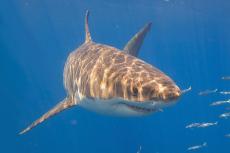
Maybe the concept of ‘responsible shark diving’ sounds a little oxymoronic, but there are many things that you can do to protect yourself and the sharks during your interaction. First and foremost, I can’t stress enough the need to gain as much knowledge as possible about the animals and their environment. To go into the water without at least a basic idea of how the sharks are likely to react is foolhardy to say the least.
Contributed by
If you are participating in an organized “shark diving experience”, you may feel that the operator’s knowledge is sufficient and that you can sit back and watch the show. It’s important to remember that every shark interaction is different. Just because countless people have watched the parade of sharks at a particular site passively swim by does not mean that you will have the same experience.
Following are some guidelines for minimising the dangers associated with interacting in the wild with sharks and rays. Whilst the advice hopefully is useful, it should be regarded as a vague guideline only.
Your experiences will differ greatly from mine, and the sharks and rays you encounter may react in a completely different way. As such, I take no responsibility for the outcome of any encounters that you may have or for the validity of any information stated below.
Get educated!
Ask local divers and fishers what species of sharks you are likely to see. Knowing if an area is frequented by nurse sharks or tigers may make a big difference to how alert you feel you need to be on the dive. Learn the stats on different sharks. The shark attack file is a good place to start to find out which sharks have been responsible for attacks in the past.
Find out how the sharks in the area normally respond to divers. Most free swimming sharks will disappear the minute they see a noisy, bubble blowing diver heading their way, but some sharks are more curious. Occasionally sharks like to wander up to divers and give them a closer look. Being buzzed or even brushed by a shark does not necessarily mean that you are about to become lunch.
Are the sharks in the area regularly fed by divers? It can be disconcerting to drop down onto an area of reef where shark feeding normally take place and immediately find yourself surrounded by expectant sharks.
Ask if bait will be used or if any member of the dive group is planning to spear fish. Aggressive behaviour is significantly increased in the presence of struggling fish or when blood and other juices are in the water.
Find out if the sharks in the area are territorial. Sharks may respond to divers as threats to territory and defensively attack.
Dress appropriately
There are differing points of view on the subject of what colors are most likely to attract a shark’s attention. Every conceivable color combination has been tried at one time or another in an effort to deter sharks from attacking. Even broad black and white stripes have been tried in an effort to replicate the appearance of a banded sea snake, which is an animal avoided by the majority of shark species.
As a rule of thumb, tropical sharks are mainly fish eaters and as such are attracted to bright and shiny objects. Therefore, it would seem logical that a neon yellow wetsuit would attract the attention of sharks looking for a meal. In shark diving circles, neon yellow has actually been given the nickname of “yum yum yellow”. Other bright colours may also have the same effect, so if you’re planning on regularly putting yourself in the presence of tropical fish eating sharks, it may be a good idea to tone down your fashion statement and choose a more muted color or black. Bear in mind that thousands of divers swim with tropical sharks every day wearing all manner of clothing from bikinis to camouflaged full body dive skins, and the incidence of attack is extremely low.
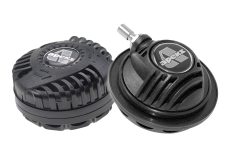
If you have bright metal objects such as reels or dive knifes attached to the outside of your BC, try to stash them out of sight in a pocket or replace them with darker coloured alternatives. Even a shark diver’s first stage can look good to a hungry reef shark, as I found out in the Bahamas.
Wear dark gloves. From a shark’s point of view, there’s nothing more tempting than seeing two small lily white “fish” flapping around in front of them. If you don’t have any gloves, try to keep your arms folded across your chest. Using your hands to swim with is asking for trouble.
Full suits are better than shorty wetsuits. This is the same principle as exposing your hands. Try not to expose distinct areas of skin that a shark can focus on or mistake for a fish. Even if you have dark skin, it’s a good idea to cover up. A lot of injury can occur from the brush of a shark’s sandpaper-like skin.
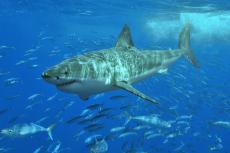
Some sharks in temperate seas feed on seals and sea lions. The chances are that you will never see a white shark underwater. I have a friend that lives on Catalina Island who has seen a couple, but he considers himself very lucky indeed to have done so. Many divers prefer the tough guy black commando look, and this is reflected by the choices of suits that manufacturers offer. Personally, I think that mimicking a seal doesn’t seem like such a good idea.
Keep in mind again that there are plenty of fish eaters in temperate seas as well, including smaller white sharks, so flashing bright colours and shiny objects may also be unwise. I own a nice neutral blue dry suit that hopefully differentiates me from both pinnipeds and schools of fish.
Lastly, fins tend to be prime targets for bites. This is more likely to do with their movements and exposed position rather than colour but white, silver, or bright fins should probably be avoided.
Avoid erratic movements
Sharks are able to pick up on disturbances in their environment. They are looking for the tell-tale signature of a wounded fish or other animal. Once they find one, they carry out their civic duty and remove the wounded creature from the gene pool.
Thrashing around in the water may mimic the vibrations sent out by a wounded fish and/or may replicate the movements of a feeding shark. Either way, slow, rhythmic fin strokes are more likely to be ignored. Good buoyancy is also important. Crashing into the reef or struggling to stay down could generate interest or may work in reverse and drive away sharks, which you were hoping would stay around.
Look but don’t touch
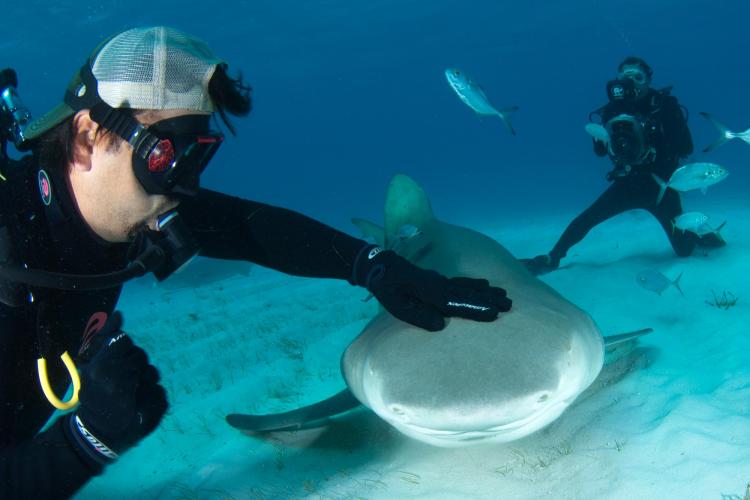
The best way to get bitten by a shark is to grab it by the tail or any other part of its anatomy. You wouldn’t think this needs putting into print, but a surprising amount of shark bites are the direct result of divers trying to manhandle otherwise docile creatures.
Joe shark diver sees a nurse shark’s tail protruding from under the reef and thinks that if he gives it a little poke or tug, the nurse shark will shift into a position where Joe can get a better look at its head. He grabs the shark’s tail, and before he has time to register exactly what has happened, he looks down to find a nurse shark jaw wrapped around his wrist.
Contrary to popular belief, nurse sharks do have rows of sharp little teeth, and once Joe is finally released (which sometimes doesn’t happen until he is literally dragged out of the water) Joe gets to spend the rest of his holiday, at the very least, with a bandaged arm.
Don’t be Joe Shark Diver. Sharks are extremely flexible and explosively fast.
Rays usually remain very docile if you approach them slowly until their personal space is encroached upon, and then they finally either bolt or slowly lift off the bottom and relocate a few meters away. The best way to get near them is to move in close to the sea bed. Rays feel more threatened when approached from above.
In rays, the two defence mechanisms that a diver needs to be aware of are: the stingray’s tail barb and the electric ray’s ability to shock.
Waders (often fishing) have been wounded and even killed where medical attention was not available, as the result of stingray barbs entering the abdomen or other vital organs. The barbs often carry toxins, which compound the medical problem and create immense pain. Luckily divers are rarely faced with stingrays using this defence mechanism, as it is only employed as a last resort when the animal is pinned down. Stingrays are more than happy to move away if they are too closely approached by a diver.
I am not aware of a single diver that has been stabbed whilst on a dive. This is not to say that you won’t step on one with painful results whilst attempting a shore entry. If this occurs, wash the wound in fresh water and apply as much heat to the area as possible. This will help to break down the toxins and relieve some of the pain. Seek medical attention as soon as possible. Stingray barbs often break up upon entry, and the wound may need to be cut open and cleaned to avoid infection.
The electric organs of some rays are potentially dangerous, but again, in the majority of cases, the ray is far more likely to move away than to shock. However, torpedo rays are known to have a bad temper, and there have been a few cases of these animals chasing divers and repeatedly shocking them. Some torpedo rays have been shown to be able to emit in excess of 200 volts! Usually, if the animal is not harassed, it will leave divers alone.
Stay away from the chum
Sharks that come to a shark feed are not there to socialise. They want food, and if you’re between them and dinner, you’re in the wrong place at the wrong time. Keep your distance from any hanging bait that has been placed in the water, and if the current is moving a chum slick away from the area, make sure that you are positioned off to the side or up stream.
Having watched the shark’s behaviour for some time, you may feel confident about moving in for better pictures or a better look. Remember that if the current is running and you are down stream, any sharks that are swimming up to the bait may think that those delicious odours are emanating from you. Now you’re stuck in a position where a shark is coming toward you, and you are drifting into it. As it’s very hard to swim against even a mild current, you probably now have to turn around to make headway against it to get back up stream, which puts you with your back to the approaching shark. A better course of action is to swim sideways until clear of the chum slick, at which point, you can kick up current without looking like a fleeing wounded animal.
Get underwater
Floating at the surface in the presence of sharks sends the wrong message. You want to descend as soon as you can for a few reasons:
Firstly, a body floating at the surface is high on the list of desirable objects for a shark to explore. In the ocean, dead things float. Oily chum tends to create a slick on the surface that you may be covering yourself in while you remain there. Secondly, if your head is above water, you are effectively blind to the movements of any sharks underwater. Thirdly, a positively buoyant diver’s actions are far more limited. It takes time to become negative and descend out of trouble, and swimming at the surface in dive gear looks an awful lot like a thrashing animal.
Read the sharks
It’s important to pay attention to the behaviour of the sharks participating in a shark feed. Although sharks become agitated as soon as they know food is available, they will usually continue to cruise around calmly waiting for the opportunity to strike at the bait. In a well-organized feed, access to the bait is often restricted to keep the sharks interested but not overexcited.
If too much bait ends up in the water, the sharks may become very aggressive. They may chase each other tearing at the food, and in their single-mindedness, any divers that get in the way stand a chance of getting hit. To understand the significance of being thumped by a shark underwater, it’s necessary to look at the medium the sharks are moving through. If an adrenalin-filled dog were to hit you at 20 miles an hour, it would bowl you down.
Now replay this scenario in a medium 800 times denser than air, and you don’t get bowled over anymore because you’re supported by the water. However, the object hitting you is still travelling at the same speed resulting in a tremendous impact. Even a leisurely swimming shark can hurt a diver, but sharks rarely collide with anything unless they are panicked. Pay attention to the dynamics of the feed.
Beyond a critical level of excitement, sharks may become too aggressive for divers to safely remain in the water, and it is difficult to judge when this point is approaching. If many sharks are in attendance and ploughing into the food, seemingly indifferent to anything else around them, they may become excited enough to bite randomly at whatever is close to them. Often the surprising thing is how fast the pace can change.
Some sharks regardless of food stimulus may become aggressive towards divers. Any type of posturing is a bad sign. The threat display of grey reef sharks has been well documented. This consists of exaggerated swimming motions, back arching, raising of the snout, lowering of the pectoral fins and head swinging. Not all sharks will give you these visual cues, but you may see some small modified behaviour. The message is a clear one: BACK OFF!
Hopefully the diver will notice the posturing and move away before the shark takes its next defensive strategy, which is often to attack. The most common scenario in which this situation occurs is when a shark is cornered. Try to always give sharks an escape route.
It may be tempting to want to photograph posturing behaviour, but this has proven to be the downfall of numerous divers in the past. A camera flash is often the catalyst that brings on the final attack. Even bringing a camera up to eye level may be enough to push a shark over the edge, and it’s important to remember that no matter how ready you think you are, if a shark attacks at speed, you are unlikely to be able to block the attack in time.
Be a responsible participant
We have come a long way since the early days of Jacques Cousteau pitting himself against the monsters of the sea. The survival of the sharks that cruise today’s oceans hangs in the balance. There is no excuse for harming any shark or even interrupting important behaviours such as mating or birthing. If you feel that a shark diving situation may require the use of a power head or other weapon for protection, then the dive should not take place.
It is also important to protect the fragile environment that sharks and rays inhabit. “Getting the shot” is secondary to protecting the reef regardless of what the subject is. Always practice good buoyancy skills, and if the situation calls for you to crouch inconspicuously on the sea floor, find a barren spot that will not damage any corals or other marine creatures. That group of orange sponges may make for a better photo location but not at the expense of the surrounding corals.
If baiting sharks into an area is enough to create a worthwhile experience, then actual feeding is not necessary. The consensus is that it is far more harmful and behaviour changing to actually feed sharks than to just lure them into the area.
Try to avoid creating a repetitive feeding area where resident sharks wait for a handout. Whilst this may be a convenient way to re-attract sharks, it provides an easy target for unscrupulous shark fishers.
Diving with sharks can be a fun and highly rewarding activity, but this becomes hollow and selfish enjoyment if you in any way harm the animals that you have come to see.
Published in

- Log in to post comments