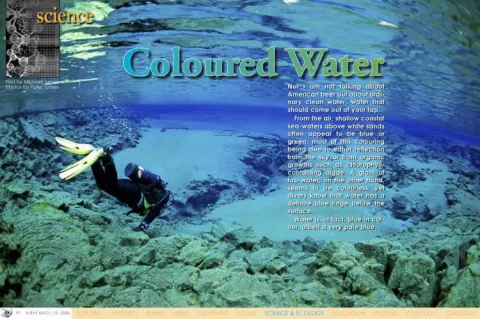
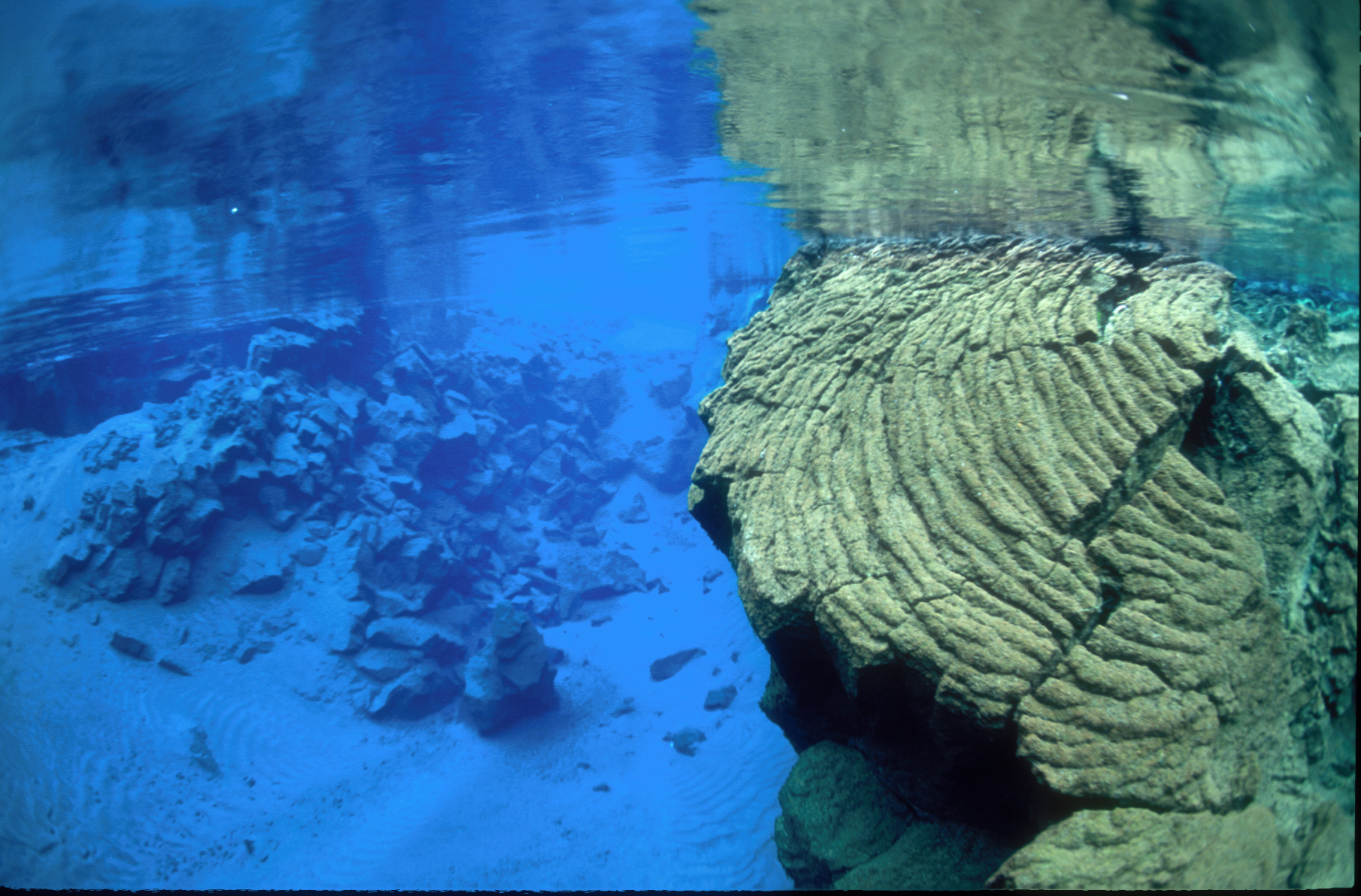
No! I am not talking about American beer but about ordinary clean water, water that should come out of your tap. From the air, shallow coastal sea-waters above white sands often appear to be blue or green, most of this colouring being due to either reflection from the sky or from organic growths such as chlorophyll containing algae. A glass of tap water, on the other hand, seems to be colourless, yet divers know that water has a definite blue tinge below the surface. Water is, in fact, blue in colour, albeit a very pale blue.
Contributed by
This colour arises from very weak absorptions at the yellow-red end of the electromagnetic spectrum. The visible part of this spectrum stretches from the UV region, starting at a wavelength of about 380 nm, to the start of the infra-red region, at about 770 nm. These are the wavelengths that can stimulate the retinal cells of the eye and which give rise to the perception of colour.
Molecular Vibrations
Now, absorptions occur when a molecule can vibrate in harmony with the radiation falling on it. Thus, if a water molecule can vibrate at a frequency of about 4.28 x 10¹⁴ vibrations per second then light having this frequency, which has a wavelength of 700 nm, and which is perceived as red, will be absorbed by the molecule. And if you remove some of the red light from white light then it will appear bluish. ...
Colour |
Wavelength nm (10-9m) |
Frequency 1014 sec-1 |
|---|---|---|
| Start of Infra-Red | 770 | 3.89 |
| Red | 700 | 4.28 |
| Yellow | 600 | 5.00 |
| Green | 500 | 6.00 |
| Blue | 400 | 7.50 |
| Start of Ultra Violet | 380 | 7.89 |
Molecular Vibrations
Now, absorptions occur when a molecule can vibrate in harmony with the radiation falling on it. Thus, if a water molecule can vibrate at a frequency of about 4.28 x 10¹⁴ vibrations per second then light having this frequency, which has a wavelength of 700 nm, and which is perceived as red, will be absorbed by the molecule. And if you remove some of the red light from white light then it will appear bluish.
Amount of light absorbed
To find the total absorbtion of light over a passage-length of l cm we use Lambert’s Law, which states that each layer of equal thickness absorbs an equal fraction of the light which traverses it. The constant a is called the absorption coefficient, and is defined for a given unit of length and a given wave-length. Lambert’s Law can therefore be expressed in the equation:
Il = Ioe-al
Where Io = intensity of incident light and Il = intensity after passage of length l.
The intensity of the transmitted radiation thus falls exponentially with the thickness of the substance being transversed.
We can illustrate this with the example of water. The absorption coefficient of water at 700 nm is 0.006 cm-1 i.e. 0.6 % is absorbed per cm. This means that for a glass of water in which the thickness of the water is 6 cm, the intensity of the transmitted light of wavelength 700 nm will be 96.5 % of the initial intensity, with just 3.5 % of it being absorbed. This small change in the composition of the light is hardly observable.
On the other hand, however, with a thickness of 5 meters of water the transmitted light of 700 nm wavelength will only have an intensity of 4.98 % of that of the incident light i.e. 95.02 % of it will have been absorbed. Removal of so much red light will give the water a distinctive blue tinge.
How Do These Absorptions Arise In Water?
A free water molecule has three basic vibrations. These are:
(I) The symmetrical stretch, v1
This has a vibrational frequency of 1.05 x 10¹⁴ sec-1
(II) The symmetrical bend, v2
This has a vibrational frequency of 0.48 x 10¹⁴ sec-1
(III) The antisymmetrical bend, v3
This has a vibrational frequency of 1.14 x 10¹⁴ sec-1
The mean H–O bond-length in the water molecule is 0.096 nm.
Harmonic overtones
From the table above it will be seen that these frequencies lie well below those of the visible range. However, there can be both overtones, or harmonics, and also combination tones, of these frequencies, given by (av1 + bv2+ cv3), where a,b,c are integers not all = 0.
For example, 2 v1 will be an absorbable harmonic, giving an absorption at 1428 nm, which is still in the infra-red region. For such vibrations to lie within the visible range there would have to be very high harmonics such as v1 + 4v3 , which would give an absorption at 534 nm, a green wavelength. At any one time, however, there will be only a relatively few molecules with these complex resonances. These will therefore be too weak to be detectable.
The influence of hydrogen-bonding
We have previously had occasion to refer to the effect of hydrogen-bonding on the properties of water. Here, hydrogen-bonding causes a stronger bonding in the molecules of water which, because strong bonds resonate at higher frequencies than weaker bonds, raises the frequency of the vibrations. The resulting absorption spectrum is quite complex, with many bands in the infra-red but now also with some weak absorption bands reaching into the red end of the spectrum. It is these weak bands which cause the water to appear slightly blue.
The plot shows the absorption coefficient of water as a function of wavelength.
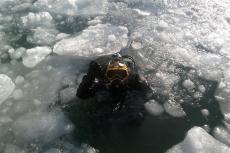
Hydrogen-bonding in ice is similar in magnitude to that in liquid water. Ice has therefore also a pale blue colour, which it is easily discernible in the solid ice of glaciers and icebergs.
It might be thought that some other hydrogen-containing liquids besides water would possess traces of a bluish colour because of similar absorption patterns. However, water and ice are the only two chemical substances that we normally have the opportunity to observe in pure form in sufficiently large bulk so that such a weak coloration becomes detectable. ■