When you are on the way back to the harbor after the afternoon dive, wild dolphins often swim in front and along the dive boat. They seem to love following boats. Sometimes they then perform for us, in form of huge jumps out of the water and “tail shows”, keeping the tail up for minutes remaining still in the water.
Factfile
More than 30 species
Dolphins, whales and porpoises are placed in the scientific order Cetaceans. Cetus is Latin and is used in biological names to mean “whale”. It’s original meaning, “large sea animal,” was more general. It comes from the Greek word ketos (“sea monster”).
Cetology is the branch of marine science associated with the study of cetaceans.
Shapes and form
Cetaceans are the mammals most fully adapted to aquatic life. Cetaceans are nearly hairless, and are insulated by a thick layer of blubber. As mammals, cetaceans have these characteristics that are common to all mammals:
— They are warm-blooded animals.
— They breathe in air through their lungs.
— They bear their young alive and suckle them on their own milk.
— They have hair - though generally only a few ‘whiskers’.
Another way of discerning a cetacean from a fish is by the shape of the tail. The tail of a fish is vertical and moves from side to side when the fish swims. The tail of a cetacean - called a “fluke” - is horizontal and moves up and down instead.
My biggest surprise was to see how fast these beautiful animals actually swim underwater. One of these young dolphins tried to teach me her kind of swimming, but quickly gave up on such a clumsy student. This recent first encounter made me think about how much – or how little - do we actually know about dolphins: their biology, ecology and behavior?
In captivity
Much of what we knew was about dolphins was, until quite recently, entirely based on studies of animals in captivity and only from the species of bottlenose dolphin, i.e. “Flipper”, Tursiops spp, and the orca or killer whale Orcinus orca.
From these studies we know they talk, i.e. they have a language and there are even different dialects among some groups of orca, that they have complicated relationships and they have a culture. The latter is currently the subject of a lot of attention and debate among scientists as it is argued that animals with a culture should have this quality included as regards to conservation issues.
Fortunately, in recent years field-based studies have been on the increase which has provided us with many new insights into the fascinating lives of dolphins. We will present some of the known facts as well as some of the many newest findings.
Dolphin Sonar
Dolphins contain a unique sensory organ which is used for hunting and communication: the organ for echolocation, which also bats possess. Echolocation is also known as “dolphin sonar”. By listening to the echoes of the sound they produce, dolphins can locate objects and fish with amazing achievement.
A dolphin is capable of creating an acoustical image of its environment, including other animals, by using the pulses of ultrasonic sound which bounce off surrounding objects, almost like an x-ray image. Even when captive dolphins are experimentally blinded they are still able to echolocate to make their way to whatever the target is.
The echolocation sounds like a bunch of clicks or squeaking sounds, however, they are beyond the field of human hearing. Dolphins are capable of pick up minute objects with their echolocation with outstanding accurateness. It is still not quite clear how the dolphin sonar system works. The echolocation may be in its lower jaw. If this jaw is covered experimentally, dolphins have difficulties echolocating.
Another hypothesis says that the ear canals, even though this is a reduced organ in dolphins, are where the centre of echolocation is. Dolphins can learn about its surroundings by measuring how long echoes take to come back. They can discriminate between the densities of objects. They can apparently even distinguish between different species of fish.
This is, of course, used when they hunt: echolocation is used in the detection and tracking of prey. Some scientists think that the eco sound can stun fishes: It is thought that dolphins stun large schools of fish with the sound beams and then make the attack.
Building knowledge
Much is still poorly understood about the echolocation ability in dolphins, but progress is made every year. One of the leading researchers within the field of dolphin echolocation is Dr. Au from the University of Hawaii.
In a recent interview, he says the following of some of his new research results: “We recently discovered that by looking at echolocation signals from wild dolphins that they have a form of automatic gain control or a form of time-varying gain. Now they do it very different than our sonar would do it. In technological sonar, time-varying gain usually occurs with the receiver, where the gain of the receiver is increased as a function of time.
But with the dolphins, what happens is that they control the level of their emissions so that as they close in on a target, they reduce the amplitude of their signal so that they try to keep the amplitude of the echo relatively constant.”
Dolphin society
Aspects of the social structure, language and learning abilities in dolphins
The Mexican dolphin researcher Dr Carmen Bazúa-Durán recently conducted a comparative study on the ability of spinner- and bottlenose dolphin to whistle which seems to be a kind of “language” that at least some species of dolphins possess beside their sonar system.
She tells the following about her and other researcher’s recent findings of the social structure and language in dolphins: “Bottlenose and Spinner dolphins live in coastal and oceanic waters of the world’s oceans. Bottlenose dolphins inhabit tropical and temperate zones with herd sizes that range from 1 to 30 animals in coastal areas and up to hundreds in oceanic waters.
Spinner dolphins inhabit tropical and subtropical zones with herd sizes that range from 2 to 300 in coastal areas and up to thousands in oceanic waters. Spinner dolphins rest and socialize during the day, feeding at night on fish in the open ocean, whereas bottlenose dolphins rest, socialize, and feed both during the day and night. Bottlenose and spinner dolphin acoustic emissions or phonations can be classified into two general categories:
- tonal whistles, and
- pulsed sounds
- or clicks.
Whistle spectrogram
Dolphin whistles have typically been characterized in terms of their frequency as a function of time (spectrograms) which is also referred to as ‘‘whistle contour’’. Whistles are frequency modulated sounds with a fundamental frequency usually below 20 kHz and harmonics up to 100 kHz and durations between 0.05 and 3.2 s.
Whistles are considered signals used to regulate group organization and function. The study of dolphin whistles has included the categorization of whistle contours into classes and the extraction of acoustic parameters from each whistle contour.”
The two American dolphin researchers Dr Rachel Smolker and Dr. John. W. Pepper recently documented a previously unknown whistle “union” phenomenon among adapted free-living male bottlenose dolphins. During a four year study period, three males formed an alliance, spending most of the time together and cooperating “herding” females: small gangs of males kidnap females and keep them for a considerable time span for mating.
Within the male individuals studied by Dr Smolker and Dr Pepper, the whistle repertoires were more variable than expected, based on previous studies, mostly performed with captive dolphins, but became less so during the time span of the study.
Among the individuals, the distinctiveness of individual whistling repertoires decreased such that the three males were practically indistinguishable by the end of the study. The three males had formed a close “alliance” and had all reached the same point on one particular shared whistle form which they had only rarely produced before the forming the alliance.
Dolphin sex
— now we got your attention, huh?
The staff at the Dolphin research center in Florida, USA (www.dolphins.org) has been breeding bottlenose dolphins for many years and has become experts within this field. They tell the following of sex and reproduction in bottlenose dolphins: dolphins have no secondary sex characteristics.
The only way to determine a dolphin’s gender in the wild is to see a clear view of their genitals or to observe an erection, act of intercourse, or a calf swimming close to an adult presumed to be a female.
Spotting the difference
Males have two slits that look similar to an exclamation point. The long anterior slit houses the genital region, while the smaller posterior slit houses the anal region. Two small pores are present on either side of the genital-anal slit, which has been considered possible vestigial nipples. Females have one continuous slit which houses both the anal and genital openings, the anus being towards the posterior.
Females also have a set of slits housing the mammary glands. These slits flank either side of their genital slit. Occasionally females will have extra false sets of mammary slits. These extra slits are generally non-functional and could be a holdover from the dolphin’s terrestrial ancestor.
Doing it anytime
There is no actual mating season for dolphins. They mate 365 days a year, just like humans. Ninety percent of their mating activity, however, is foreplay. Intercourse only takes seconds.
Males become sexually mature between 5 to 13 years of age. Females become sexually mature a little sooner at around 9 - 14 years of age.
Playing games
Much of the amorous activity between dolphins includes chasing each other around and raking each other with their teeth.
Dolphins have a tendency to get lazy looking eyes and lay on their sides, sinking like a log, when they are feeling amorous. This seems to be the height of erotic behavior for a dolphin.
The more dominant dolphin is usually found beneath the more passive, which is playing the “floating log”.
Whenever whoever Dolphins are indiscriminately amorous. They have sex with the opposite gender, the same gender, and engage in masturbation with inanimate objects. Female dolphins have been observed suctioning things (like plates) to their genital region when they are feeling amorous.
They also seem to enjoy buzzing on each others’ slits using echolocation. What are the possible reasons for this type of behaviour—as it is not just leisure? It is believed that dolphins may possibly engage in this type of behaviour to learn about sex as well as to maintain strong social bonds for many sorts of cooperative activities. Dolphins must maintain a streamlined body to move efficiently through the ocean.
Therefore, male dolphins have both their penis and testicles packed inside their body. On mammals, testicles are usually found outside the body since sperm dies at body temperature. Dolphins compensate for the extra heat that their testicles must endure by utilizing a special feature of their circulatory system.
Pregnancy
Recent research indicates that bottlenose dolphin pregnancy lasts about 12 months. During this time, there is very little room in the uterus for a baby to develop. As a result, and to make birth easier, the tail fluke and dorsal are cartilaginous and are folded over in the uterus. The organs are also located beneath the developing baby, which could be the reason for a female gaining more girth during pregnancy and not developing a bulge. Mothers double their intake of food following the birth of their babies. Intervals between calves vary from about three to five years.
Calves
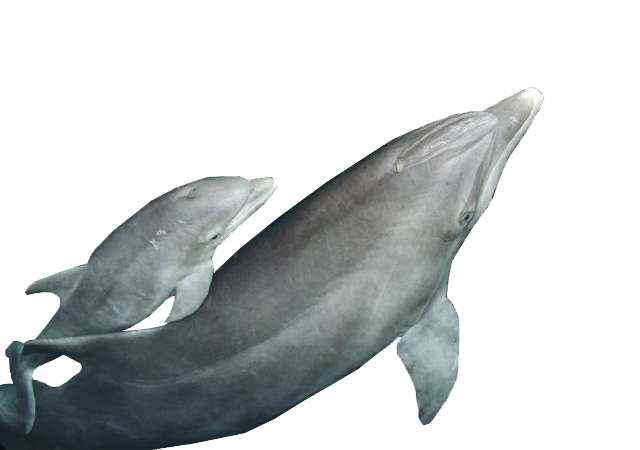
Calves are usually born tail first, weigh 25-40lbs, and are generally three to four feet long. We can get an approximate idea of how old a baby is by looking at the dorsal fin. It is thought that the dorsal fin stiffens within a few hours. The tail flukes seem to take a bit longer.
A calf swims in a position next to its mother called the echelon position. The calf swims in this position to catch mom’s slipstream, allowing the calf not to work as hard in order to keep up with its mother. When calves are born they have lighter coloured bands spanning their midsection.
These are called fetal bands and are derived from being scrunched up in the mother’s womb. These bands will slough off after multiple weeks. Newborn dolphins are very dark in colour. It is possible that this dark shading is used for camouflage as the baby travels in the mother’s shadow. This colouration is also sloughed off after multiple weeks.
Learning to breathe
When calves are new to the world, they have to get used to their bodies not only swimming but also breathing. They have to get comfortable with where their blowhole is. As a result, calves do something called chin slap breathing, which involves taking its head farther out of the water than necessary to breathe.
Echolocation is an ability that babies have to learn how to use over time. For this reason, babies end up with a few cuts and scrapes within the first weeks of life.
Due to the need to look out for a clumsy calf, you sometimes see mothers “steering” their calves away from what might be considered a danger. Calves nurse an average of about every twenty minutes or more for 24 hours a day. In the first few weeks of life this can be in more frequent intervals.
They nurse, on average, a minimum of two years but have been observed to nurse up to four and a half years. Calves have many fringes along the edges of their tongue, believed to be an aid in nursing. Calves apparently roll their tongue and clasp the fringes together in order to form a watertight funnel for the milk to flow through. Mothers take an active role in nursing by squirting the milk into the baby’s mouth.
Maternity pods
Groupings of females with calves are naturally occurring in the wild. The groupings are called maternity pods. It is important to have other females available to a mother dolphin. Female dolphins have been seen assisting in birth, and more consistently as “baby-sitters” or “aunties” helping to rear young dolphins.
One of the best ways a female dolphin can learn how to care for a calf is to be around a baby and other more experienced females. Adult male dolphins generally do not appear around females unless mating. Male dolphins tend to congregate in groups of two or three and sometimes form what is known as a pair bond.
Bonded for life
Pair bonded males will stay together for an extended period, if not all, of their lives. Male dolphins play no role in raising their young. In fact, male dolphins have been known to be a threat to the calf. Adolescent dolphins also congregate in separate groupings called juvenile pods. This will occur once a calf is old enough to leave its mother. Each female dolphin seems to have a unique mothering style. Each female dolphin seems to have a unique mothering style. Some mothers are very protective parents, while others seem more relaxed with letting their calves explore. These variations have also been observed in the wild.
Dolphin Culture
– a case for better conservation?
There is increasing evidence that culture is an important determinant of behaviour in some non-human species including great apes and whales and dolphins.
Recently, a team of Canadian, British and American researchers led by Dr. Hal Whitehead of Novo Scotia, Canada, has argued that at least in some cases, there may be repercussions for population biology and conservation in dolphins and whales. This may of course depend on how “culture” is defined.
Dr Whitehead and his team follow the definition that “culture” is information or behaviour, shared by a population or subpopulation, which is acquired from conspecifics through some form of social learning’.
A ‘‘population’’ could in these cases include the whole species, and ‘‘subpopulation’’ any subdivision of a population which contains at least a few individuals in each set. Dr Whitehead and his team argue that culture can affect behavioural and population biology, and thus conservation issues, in ways that are importantly different from those traditionally expected from a model that only includes genetic inheritance. Culture is very varied, and this variation has implications for its interactions with conservation.
Horizontal or vertical culture
For instance, contrasts have often been drawn between horizontal’ cultures, where transmission is between members of the same generation and vertical or oblique cultures where animals learn behaviour from parents or other members of previous generations.
Horizontal cultural transmission can be highly effective in quickly changing population behaviour in adaptive ways, an example being the rapid decrease in the use of certain chemicals by humans once they are shown to be toxic.
Conversely, vertical cultures, like some religions, can be highly conservative and can constrain adaptive responses to environmental change.
Cetacean Culture
Dr Whitehead and his team argue that by these criteria, culture is quite common among animals, especially those that are more cognitively advanced, such as the dolphins.
However, in most of the species possessing recognized cultural capacities, only a small proportion of behaviour seems to be determined by social learning, and much of this may be functionally neutral.
Despite difficulties in studying the behaviour of the whales and dolphins, and, compared to primates and songbirds, a lack of knowledge on behaviour, communication and social structure, there is strong evidence for cetacean cultures in the four best-studied species , and some most interesting speculations for some of the others - for instance on spinner dolphins, Stenella longirostris.
Sophisticated social learning abilities exist, at least in bottlenose dolphins and orcas.
For a range of non-human animals, culture is a vital determinant of phenotype, and so how the animals interact with humans and our cultural artifacts
Social learning
Of the several types of social learning which have been recognized, imitation is often singled out as being particularly significant for the propagation of culture.
The bottlenose dolphin can imitate both vocally and non vocally and has been shown to understand the broad concept of imitation. Some consider it the most sophisticated non-human imitator. This social learning seems to have led to culture, of various types. Among the baleen whales (suborder Mysticeti), there are several known cases of horizontally transmitted cultures.
Humpback song
The best understood horizontal culture of cetaceans is the mating song of the male humpback whale.
At any time during the winter breeding season, all the males in any ocean sing more or less the same elaborate song, but this communal song evolves over months and years. Songs in different oceans at any time are different but follow the same general syntactical and evolutionary rules.
Horizontal cultures are also found in the suborder Odontoceti, the toothed whales and dolphins. An example is the dead-salmon carrying fad of the well-studied southern resident, fish-eating, orcas of the Puget Sound area of the northeast Pacific.
The famous K-Pod
It began with a female in K-Pod carrying around a dead salmon in 1987, spread to the other two pods in the southern resident community over a 5–6 week period and then stopped. It was noted a few times the following summer, and then never again. Probably more significant from the conservation perspective are vertically or obliquely transmitted cultures.
Populations of all the well-studied odontocetes are culturally structured and subpopulations with distinct cultural trait groups are often sympatric. Among the bottlenose dolphins of Shark Bay, Western Australia, there are at least four distinctive foraging specializations, at least some of which are likely transmitted vertically from mother to daughter.
Similar population structure by foraging specializations is found in other dolphin communities, for an instance in cases of human-dolphin fishing co-operatives.
Cooperation with humans
In Brazil, there are at least two cases where some, but not all, bottlenose dolphins in a community have a long-standing and complex cooperative relationship with local fishers which are almost certainly vertically transmitted between generations of both dolphins and fishermen.
The population of orcas off the west coast of Canada is clearly structured at a number of hierarchical levels, and much of this structuring seems to be cultural. At the highest level, different types of orca (‘‘residents’’ and ‘‘transients’’) are sympatric but show sufficient differences in feeding behaviour, vocalizations, social systems, morphology, and genetics that they may be incipient species.
It has been suggested that this division was originally cultural. At lower levels, ‘‘communities’’, ‘‘clans’’ and ‘‘pods’’ of orcas may differ in vocalizations, foraging behaviour and social behaviour, but often have overlapping ranges.
Sperm whales too
The complex, stable and sympatric vocal and behavioural cultures of orca groups have no known parallel outside humans. The closest analogue is with the sperm whale, whose society is also arranged into a multi-level hierarchy, at least two levels of which may support cultural differences among sympatric groups: the approximately 10-member ‘‘social units’’ and ocean-wide ‘‘clans’’ with thousands of members each.
Dr Whitehead and his team conclude that we have heard arguments that if we are at the stage of conserving non-human cultures, then the real conservation battles have already been won. Dr Whitehead and his team disagree. For a range of non-human animals, culture is a vital determinant of phenotype, and so how the animals interact with humans and our cultural artefacts. Thus, culture should be an integral element of the conservation biology of these species: cultural organisms behave very different than those for which culture has little significance.
Published in
-
X-Ray Mag #8
- Read more about X-Ray Mag #8
- Log in to post comments