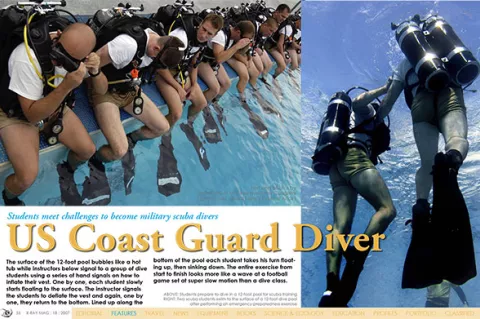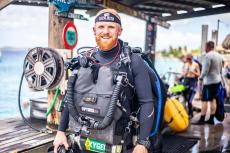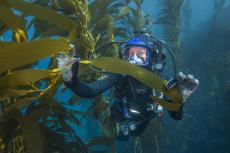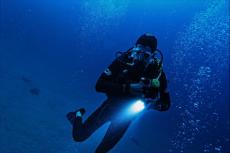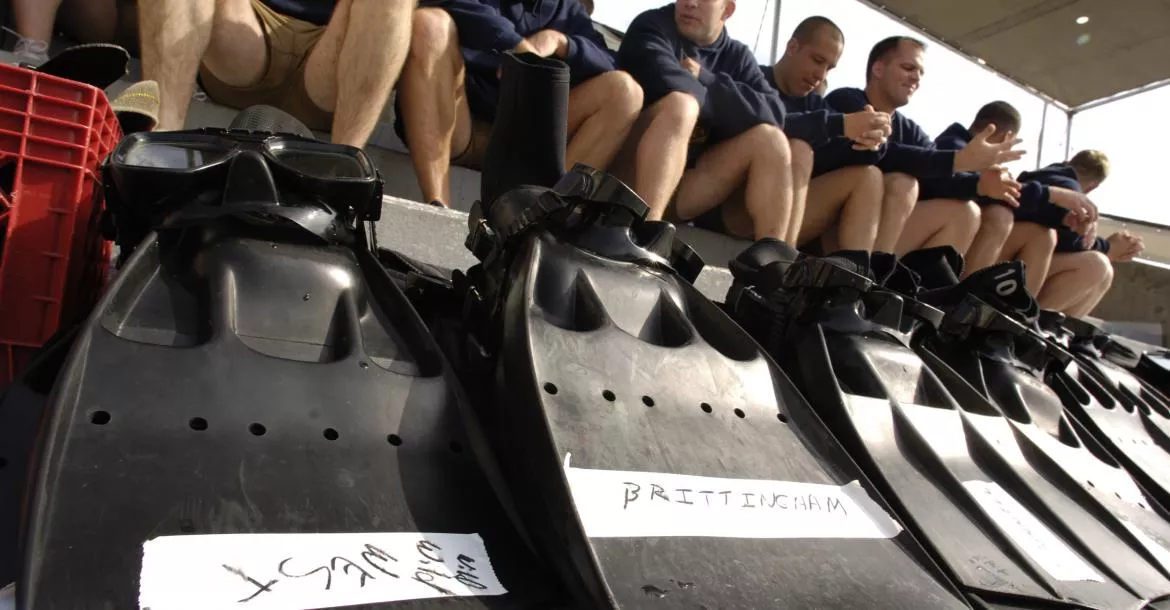
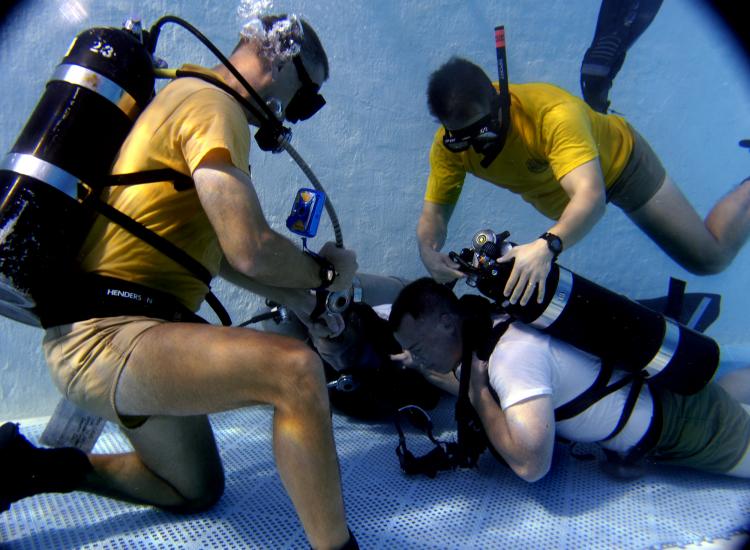
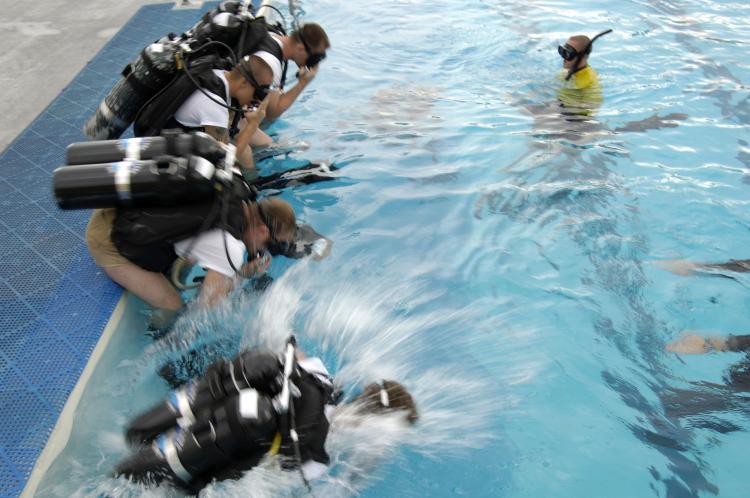
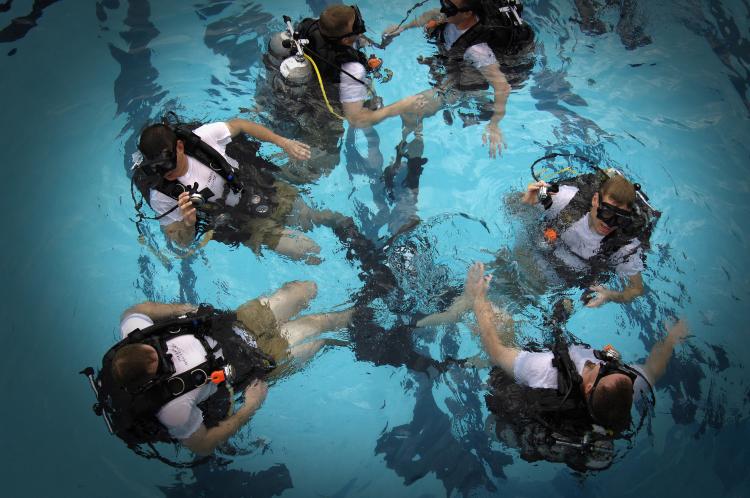
The surface of the 12-foot pool bubbles like a hot tub while instructors below signal to a group of dive students using a series of hand signals on how to inflate their vest.
Contributed by
Factfile
Do you have what it takes to be a US Coast Guard Diver?
To enroll in the Coast Guard dive program, you must:
• Be an active-duty member and volunteer to participate in the program
• Be under 35 years old
• Have an ASVAB score of AR+WK=104 and MC=50
• Have no marks less than four within the last six months
• Be in any rate other than aviation
• Be able to complete a physical fitness course as outlined:
500 yard swim (side or breast stroke) within 14 minutes
10 minute rest
42 push-ups
2 minute rest
50 sit-ups
2 minute rest
6 pull-ups
10 minute rest
1.5 mile run within 12 minutes, 45 seconds
Eligible candidates undergo an interview process, medical exam, physical screening and pressure tolerance test. Lastly, a command endorsement completes your application package.
For more information on the program, please contact the US Coast Guard Liaison Office at (850) 235-5244
“Coming here is like getting your masters degree in diving,” said Coast Guard Lt. Alan Fitzgerald, a student enrolled in the Marine Engineering Dive Officer Course at the dive center. “The academics alone are pretty tough, because you get into all aspects of diving including physics and medicine. As far as physical fitness, they train you to be strong, so you can handle yourself under the surface.”
With courses ranging from the scuba certification course to the BDO course, members from all of the United States military branches (with the exception of the Navy Seals and the Green Berets) come here to see if they have what it takes to become a military certified scuba diver.
Prior to 9-11, Coast Guard divers took to the water to perform such functions as hull-integrity inspections, buoy repair and ice research. With the formation of the Maritime Safety and Security Teams located throughout the country, the Coast Guard has increased its efforts to train and certify more of its own members to perform homeland security missions.
“Today, the Coast Guard has 112 billets as certified divers, and we train 40-50 Coast Guard members each year to sustain that number,” said Chief Petty Officer Philip Roy of the Coast Guard Liaison Office at the training center.
The right stuff
As a volunteer program for the Coast Guard, any member who meets the center’s eligibility requirements can enroll; however, attendance is not a guarantee of success. Enrollment into the dive program can be a physically and mentally challenging endeavor, requiring a large commitment from the students.
“On average, about a third of the people who enroll in the course don’t make it through,” Roy said. “We lose students primarily because of academics and inability to perform. We purposely take people out of their comfort zone while they’re here and push them to their limit, so when they’re in the field, if something was to happen, they won’t quit.”
The training is tough, and everyone is held to the same standard. Enlisted, officer, male, female, Navy, Coast Guard—it doesn’t matter. Everyone here is an equal and is expected to live up to the same physical fitness standards set forth by the training center.
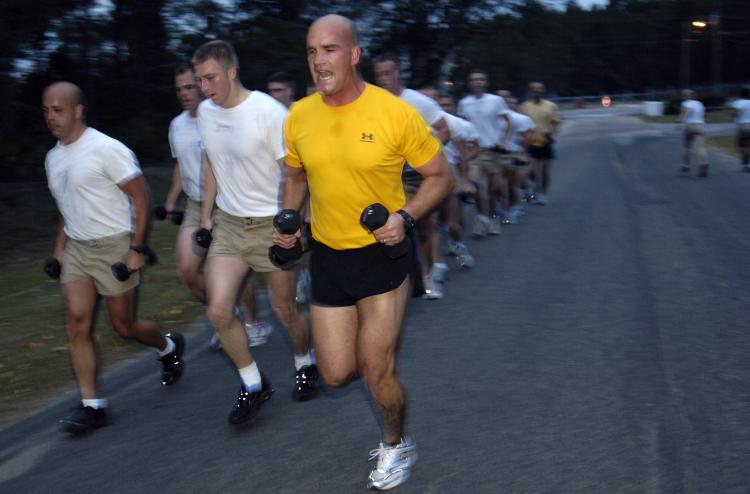
Prior to the start of class, candidates must be able to successfully complete the minimum fitness standards, including a timed fitness course.
All aspects of training are taken very seriously. When underwater, if an emergency occurs, a diver must go through the proper decompression before reaching the surface or he could suffer grave consequences, yet despite the inherent dangers associated with underwater diving, the atmosphere remains positive.
“Being a volunteer program, the students who are here, want to be here,” said Roy. “They want to get through this program, and being surrounded by that level of energy is inspiring.”
As with any type of military training, the US Coast Guard trains its divers from ground zero. Regardless if students arrive at the school with a recreational dive certification, they must still complete the course. Previous dive experience is not a requirement for school, nor will it ensure a student’s success.
“The level of training the students receive is comparable to what a recreational diver would,” said Roy. “But because our student’s are training to become military divers, they have much more dive time and exposure to the water than one would receive recreationally. You really can’t draw too many parallels between civilian and military training.” ...
Lt. j.g. Rachel Beckmann recently completed the basic scuba course and is now enrolled in the Marine Engineering Dive Officer Course. “The goal of the five-week scuba course is to basically take someone with no diving experience and train them to be a certified diver. The whole course was really intense, but it felt very rewarding to complete it,” she said.
On the job
Upon completion of the course, students move on to perform certain job functions most people only read about—diving under polar ice in the Arctic, sweeping for explosives in the nation’s ports and locating sunken buoys in a field of coral off the coast of Hawaii.
Assignments to dive units are rate specific, and a certified diver can be assigned to any of the US Coast Guard’s MSSTs, any of the service’s polar-class icebreakers and fourteenth district buoy tenders.
While stationed aboard buoy tenders, dive teams can work independently from the ship, reducing response time and cost, Roy said. The teams can perform all of the same functions as the tender crew can and are often flown to remote Pacific island locations to repair and replace navigational aids damaged by typhoons or listed in discrepancy reports.
Compensation
Certification as a Coast Guard scuba diver also carries with it the added benefit of a pay increase. Because of the nature of the job, divers receive an incentive pay ranging anywhere from US$150 to $240 each month while stationed at an operational dive unit.
The challenge for anyone wishing to become a military certified scuba diver is great, but with successful completion, a career as a US Coast Guard diver can be a rewarding one.
Those strong enough to complete the course walk away with a sense of pride and accomplishment and will forever be known as a member of the elite corps of US Coast Guard divers. ■